Having to Have a Art Degree for Makeup Quotes
Lived Experience in Art and Journalism
What are the limits of representation?
Newly-minted NYT columnist Pamela Paul explores "The Limits of 'Lived Experience.'" Her insights are not novel; indeed, information technology's been the conventional wisdom for all but perchance 5 minutes of human history.
Permit's make it personal: Am I, as a new columnist for The Times, allowed to weigh in on anything other than a narrow sliver of Gen Ten white woman concerns?
Non according to many of those who wish to regulate our culture — docents of academia, school curriculum dictators, aspiring Gen Z storytellers and, increasingly, establishment gatekeepers in Hollywood, book publishing and the arts. It's the ultimate litmus test: Only those whose "lived feel" matches the story are qualified to tell the tale.
So what is this vaunted "lived experience"? You may recognize information technology by its longstanding name, "personal experience," or less excitingly, "experience." But "lived feel," with its bawdy suggestion of authority, says to other people: Unless you take walked in my shoes, you take no business organisation telling my story.
This represents an extreme view in academia and elsewhere but it's certainly one that'south gaining some traction. Regardless, she dutifully reports the thinking behind information technology:
Hither's the argument: The dominant culture (white, male, Western, straight) has been dictating the terms for decades, effectively silencing or "erasing" the authentic identities and voices of the people whose stories are being told. The time has come up to "center" these other voices.
In do and across the arts, this means that only those people who take directly experienced discrimination or oppression, for example, or who in some way embody that experience should be allowed to portray characters, create stories or drive programming about it. They're the ones who can truly translate those tales accurately. The goal is greater share of the narrative and greater stake in whatsoever profits.
And so a more than cynical spin:
It's essentially a turf war. Only Latino authors tin write novels about Latinos. But Holocaust survivors can convey the truth of the Holocaust. Only disabled people can portray disabled people. Anybody else is out.
Again, I remember few people actually believe this except at the margins and information technology would be cool in almost circumstances. If only people who fought in the Civil War can portray Civil War soldiers, well, there's going to be a problem. Fifty-fifty more so if i is casting for superheroes, wizards, aliens, and the like. Just there is a growing sense that certain highly marginalized groups—those with severe disabilities and trans individuals come to mind—should only be portrayed by members of those groups.
This is one point of view, and as with well-nigh points of view, some of information technology is valid. Clearly those who have lived through something — whether information technology'south a tsunami or a lifetime of racial discrimination — have a story to tell. Their perspective is distinct and it's valuable.
Just information technology is, crucially, only one perspective. And to suggest that only those whose identities match those of the people in a story — whether it's the race of a showrunner or the sex of the author of a volume under review — is a miserly take on the human experience.
Surely human beings are capable of empathizing with those whose ethnicity or country of origin differ from their own. Surely storytellers have the power to faithfully imagine the experiences of "the other." If we followed the solipsistic credo of always "centering" identity when greenlighting a project, nosotros'd lose out on much of journalism, history and fiction.
Civilization is a conversation, not a monologue.
There's quite a flake more but y'all get the point. And, again, I recall it's the conventional wisdom.
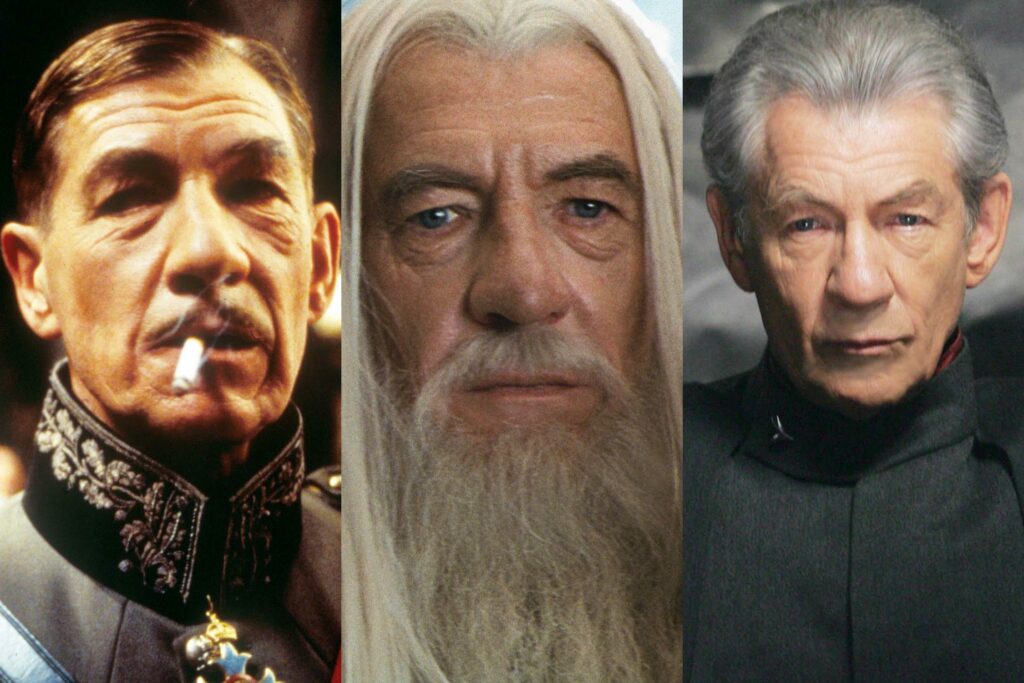
Hell, the very essence of fiction is that writers imagine worlds and create characters and circumstances. Presumably, their "lived experience" factors into that but information technology's but a starting signal. Similarly, actors pretend to be a character for the duration of a film, as Sir Ian McKellen put information technology in a archetype bit:
More than seriously, in response to the controversy over the casting of Helen Mirren to play former Israeli Prime Minister Golda Meir, McKellen responded,
"There are 2 things: Is the argument that a gentile cannot play a Jew, and is the statement therefore that a Jew cannot play a gentile?"
"Is the statement that a straight human cannot play a gay role, and, if so, does that mean I tin can't play straight parts and I'1000 not allowed to explore the fascinating subject area of heterosexuality inMacbeth?" he added.
"Surely not," McKellen concluded. "We're interim. Nosotros're pretending."
This seems obvious, correct?
Just some argue it'southward non then unproblematic:
Mirren was outset accused of engaging in "Jewface" for her role in the currently-in-product Golda in Jan, when British actress and comedian Dame Maureen Lipman stated that she disagreed with Mirren'southward casting "because the Jewishness of the grapheme is so integral."
"I'yard sure she [Mirren] will be marvelous, simply it would never be immune for Ben Kingsley to play Nelson Mandela. You just couldn't fifty-fifty become in that location," Lipman explained to the Jewish Chronicle. "Right now, representation f***ing matters. It has to also finally matter for Jews too. Especially Jewish women."
Information technology's certainly truthful that Kingsley would never be cast to play Mandela. Non so much, though, because of accusations of blackface (unless, you know, he was actually in greasepaint) just considering it would be distracting. Few complained virtually Lin-Manuel Miranda playing Alexander Hamilton or Leslie Odom, Jr. playing Aaron Burr.
But back to McKellen'due south point: does it stand to reason that, if just Jews may play Jews that Jews may only play Jews? That would exist rather limiting, no?
Withal, Lipman isn't an extremist on this:
My opinion, and that's what it is, a mere opinion, is that if the character's race, creed or gender drives or defines the portrayal then the correct — for want of an umbrella [term] — ethnicity should be a priority."
I'yard not sure I concord only information technology's certainly a defensible position. A gay man can probably e'er play directly characters and vice-versa. But perhaps if the character is stereotypically gay, it would exist preferable to have a gay homo play it?
And, indeed, Lipman goes farther:
"Which is not to say that 'Pericles, Prince Of Tyre' has to exist [played by] a pure Tyresian thespian. It is complicated," she connected. "We are really talking about lack of outcry. In a sense, I am a tiny outcry because every other creed, race or gender discussion with regard to casting [causes] tsunamis. Think Eddie Redmayne, Scarlett Johansson, Jake Gyllenhaal, Johnny Depp, Rooney Mara and, ridiculously, Javier Bardem in 'Meet the Riccardos.'"
At the terminate of the day, actors should be allowed to human action and writers to write. It would be absurd for a Hispanic showrunner to exist relegated to the "lived experience" of his ethnicity. Then once again, Miranda has been criticized for using by and large calorie-free-skinned actors of color in his casting.
As to Paul's parameters equally a commentator, surely they're rather wide? While there are those who argue that men should not annotate on issues that but direct affect women and that whites should not counterbalance in on issues that primarily touch people of color, that'due south a rather fringe position, no?
Source: https://www.outsidethebeltway.com/lived-experience-in-art-and-journalism/
0 Response to "Having to Have a Art Degree for Makeup Quotes"
Post a Comment